Anyone who has seriously job hunted recently knows the drill. You spend hours scrolling job boards, tweaking your resume for each application, writing cover letters that may never get read, and waiting for responses that often never come. It is exhausting, and most of the effort feels like it disappears into a black hole.
In 2026, that process is changing. AI-powered job search tools are handling the parts of job hunting that eat the most time and deliver the least return. The shift is not small. It is the biggest change to how people find work since LinkedIn went mainstream.
The Problem with Traditional Job Searching
The average job seeker spends about 11 hours per week searching and applying for roles. A large chunk of that time goes to things that are genuinely repetitive. Finding relevant listings across different job boards. Reformatting a resume to match a job description. Writing a cover letter that does not sound like a template even though it kind of is.
At the same time, the volume of applications needed to land an interview has gone up. Hiring managers at competitive companies receive hundreds of applications per role. Getting through requires both volume and precision, which is a hard combination to achieve manually.
That tension, between the need to apply broadly and the need to apply well, is exactly what AI is built to resolve.
What AI Job Search Tools Actually Do
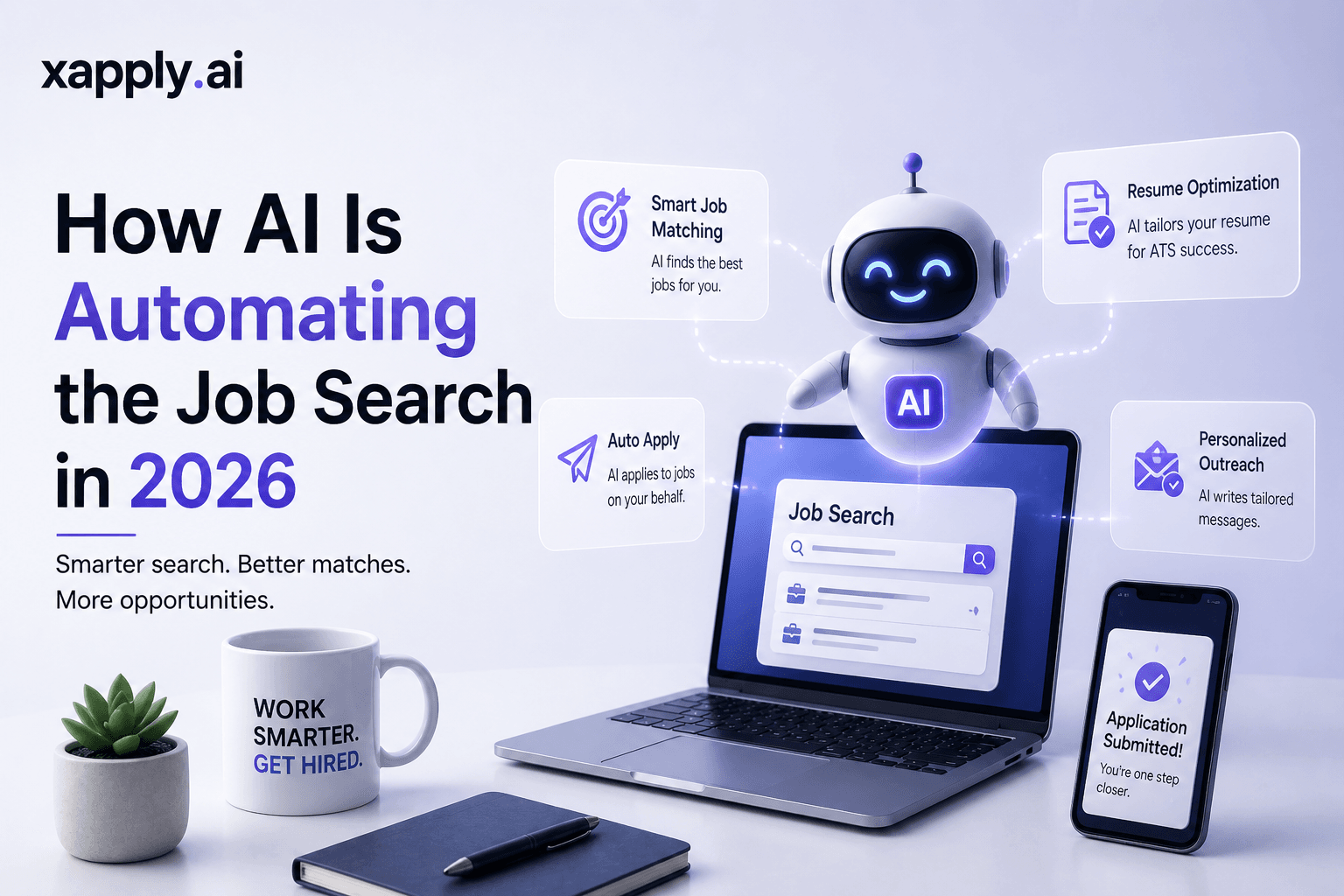
The new generation of AI job search tools does not just surface listings. It handles the full pipeline. Starting with matching, these tools pull relevant openings from across major job boards and filter them against your skills, experience, and preferences. You are not manually searching Indeed, LinkedIn, Glassdoor, and a dozen niche boards separately. The AI does that for you.
Then comes personalization. This is where the real value shows up. Instead of sending the same resume to every role, AI tools analyze each job description and tailor your resume to highlight the most relevant experience and match the language the employer is actually using. The same happens with cover letters. Each one gets written to fit the specific role, not recycled from a generic template.
After that, the application goes out automatically. No copy-pasting. No manually filling in the same fields on fifteen different forms. The system handles submission and tracks the status of every application in one place.
This is exactly how xapply works. It connects to major job boards, matches you with relevant openings based on your profile, uses AI to tailor your resume and cover letter for each role, and applies on your behalf. For someone actively searching, the difference between using xapply and doing it manually is applying 10 times faster with better-matched applications at every step.
The ATS Problem and How AI Fixes It
Most mid-to-large companies use Applicant Tracking Systems to screen resumes before a human sees them. ATS software scans for keywords, formatting, and relevance signals. A resume that is well-written but uses the wrong terminology for a specific role can get filtered out automatically, even if the candidate is a strong fit.
AI tools solve this directly. By reading the job description and mapping it to your resume, they ensure the right keywords show up in the right places. Not stuffed in awkwardly, but woven naturally into the way your experience is described. This alone significantly improves the rate at which applications make it past the first filter.
Who Benefits Most from AI-Powered Job Search
The obvious answer is anyone actively job hunting. But the less obvious use case is passive candidates, people who are currently employed but open to the right opportunity. With automated job search running quietly in the background, you can stay informed about the market without spending hours on it every week.
Recent graduates also benefit significantly. Early-career candidates often apply to a wide range of roles while they figure out where their skills fit best. Doing that manually is brutal. With AI handling the volume, they can cast a wide net without burning out.
Career changers are another group that gains a lot. Reframing your experience for a new industry requires real skill in how you present yourself. AI tools that tailor your resume for each role do a lot of that heavy lifting automatically.
What You Still Need to Do Yourself
AI can get you to the interview. It cannot close it for you. The interview itself, the way you tell your story, the questions you ask, the impression you make, those remain entirely human. AI handles the grunt work of getting your application in front of the right people. What happens after that is still yours.
The same goes for networking. Building genuine relationships with people in your target industry still opens doors that no algorithm can. AI and human effort are not competing. They work best together.
The Takeaway
The job market in 2026 is competitive by any measure. The candidates who move fastest, apply smartest, and show up with tailored applications at scale are the ones getting interviews. AI-powered job search tools make all of that possible without turning the process into a second job.
If you have not tried automating your job search yet, the gap between doing it manually and using a tool like xapply is larger than you think. The time you save is real. The improvement in application quality is real. And in a market where timing matters, the speed advantage is not something to leave on the table.
Related articles
AI Job Apply: Why xApply Is the Smartest Way to Apply for Jobs in 2026
Job hunting shouldn’t feel like a second job. xApply uses AI to tailor resumes and cover letters and handle repetitive applications so you can focus on roles that fit, without sacrificing quality for quantity. Tweak the tone to match your site (more formal or more punchy) if you want.
Read postWill AI Take Your Job or Help You Get One
The fear is understandable. But the reality of how AI is reshaping work in 2026 is more nuanced, and more interesting, than the headlines suggest.
Read postWhy Your Resume Needs AI to Get Past ATS in 2026
Most resumes never reach a human recruiter. They get filtered out by software long before that. Here is how AI is helping candidates actually get seen.
Read post