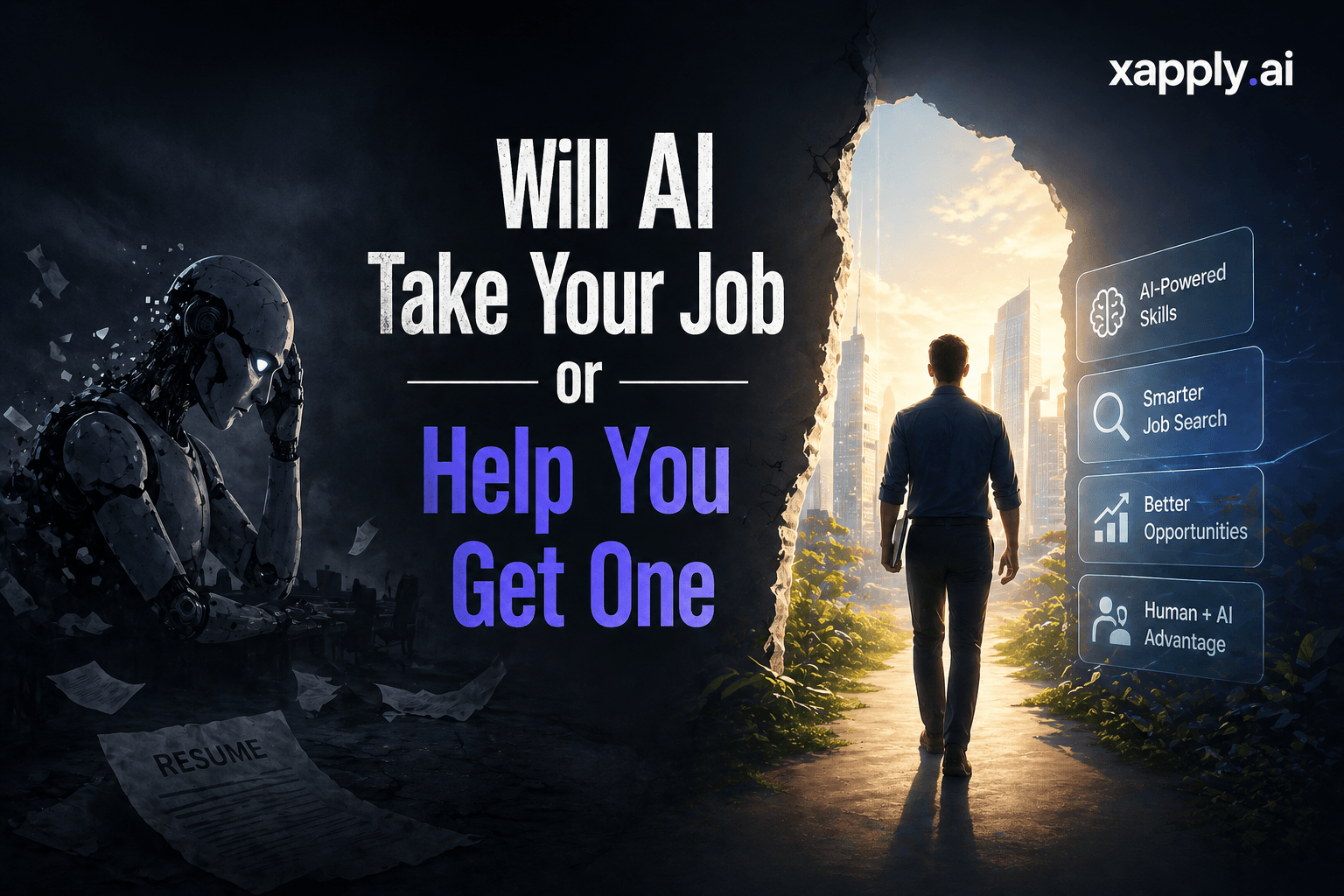
Every few months, a new report drops with a headline that sends a chill through the workforce. X million jobs at risk from AI. Entire industries on the verge of automation. White-collar roles not safe anymore. The anxiety is real, and it is not entirely misplaced.
But the picture that emerges when you look at what is actually happening in the job market in 2026 is more complicated than simple displacement. AI is eliminating certain tasks, creating new ones, changing what employers want from candidates, and in some cases actively helping people find better jobs faster than ever before.
Understanding which side of that equation you are on comes down to one thing: what kind of work you do and how much of it can be reduced to a repeatable process.
What AI Is Actually Replacing
The clearest targets for automation are tasks, not jobs. Very few roles get eliminated entirely all at once. What tends to happen is that the repetitive, rule-based components of a job get absorbed by AI, while the judgment-heavy, relationship-driven, and creative components remain with people.
Data entry, document summarization, basic customer service queries, scheduling, first-pass research, and routine report generation are all areas where AI is now doing the work that used to take significant human time. In some industries, that has meant headcount reductions. In others, it has meant the same team can now handle dramatically more work.
The roles feeling the most pressure are ones where repetitive task work makes up the majority of the job. Junior data analysts, entry-level paralegals, basic content writers, and certain administrative functions are all in categories where AI handles a growing share of the actual output.
What AI Is Creating
The flip side is real too. The rise of AI is generating genuine demand for new skills and new roles. Prompt engineering, AI model training and evaluation, workflow automation design, AI governance, and agent oversight are all areas where companies are actively hiring right now.
Beyond the explicitly AI-labeled roles, there is broader demand for people who are comfortable working alongside AI tools, who know how to evaluate AI outputs critically, and who can translate between what the technology can do and what the business actually needs. That combination of technical literacy and domain expertise is genuinely rare and genuinely valued.
There is also a macro-level dynamic worth keeping in mind. Technology has displaced categories of work throughout history, and in every case, new categories eventually emerged. That does not make the transition easy for individuals caught in the middle, but it does suggest that the long-term picture is not simply fewer jobs.
The Skills That Are Holding Their Value
Across industries, certain qualities are becoming more valuable as AI handles more of the execution layer. Critical thinking and the ability to evaluate outputs rather than just produce them. Communication skills that can translate complex ideas clearly to different audiences. Emotional intelligence and the ability to navigate human dynamics that no algorithm can replicate. Strategic judgment in ambiguous situations where there is no clean right answer.
These are not soft skills in the dismissive sense. They are the capabilities that separate people who can manage AI-augmented workflows from people who are simply feeding inputs into a tool.
Microsoft's research framed it well: the future is not about replacing humans, it is about amplifying them. A three-person team using AI intelligently can now execute what used to require a much larger team. That changes what it means to be competitive as an employee.
How AI Is Helping People Get Jobs
There is another angle to this that gets less attention. While AI is changing what jobs look like, it is also making the process of finding those jobs substantially easier for candidates who use the right tools.
Platforms like xapply use AI to handle the most time-consuming and repetitive parts of job searching. Matching you with relevant roles across major job boards, tailoring your resume and cover letter to each position, and applying automatically on your behalf. For someone navigating a tough job market or managing a career transition, that kind of efficiency is not a minor convenience. It is a real competitive edge.
The irony is worth naming: AI is both displacing certain roles and simultaneously becoming one of the most powerful tools available to people who need to find new ones.
What to Do If You Are Worried About Your Role
The most practical thing you can do is an honest audit of your current job. What parts of it are genuinely creative, relational, or judgment-based? What parts are essentially rule-following that could be automated with the right system? That split tells you where your value is concentrated and where you might be vulnerable.
If the vulnerable parts are significant, that is not a reason to panic. It is a reason to start building skills in the direction of roles that lean on the capabilities AI currently lacks. Curiosity, adaptability, and a willingness to actually engage with AI tools rather than avoid them are all things you can work on right now.
The Bottom Line
AI will not take your job in one fell swoop. But it is changing what every job requires, what employers are paying for, and how fast the market moves. The professionals who end up ahead are the ones treating AI as a tool to use, not a threat to wait out.
That means getting comfortable with AI-powered tools in your workflow, building the skills that AI cannot replicate, and yes, using AI to help you navigate the job market itself when the time comes.
Related articles
AI Job Apply: Why xApply Is the Smartest Way to Apply for Jobs in 2026
Job hunting shouldn’t feel like a second job. xApply uses AI to tailor resumes and cover letters and handle repetitive applications so you can focus on roles that fit, without sacrificing quality for quantity. Tweak the tone to match your site (more formal or more punchy) if you want.
Read postHow AI Is Automating the Job Search in 2026
The job search used to be a full-time job in itself. In 2026, AI is taking over the repetitive parts so you can focus on actually landing the role.
Read postWhy Your Resume Needs AI to Get Past ATS in 2026
Most resumes never reach a human recruiter. They get filtered out by software long before that. Here is how AI is helping candidates actually get seen.
Read post